

Why Custom Websites Boost Automotive Growth
- Feb 23
- 12 min read

Standing out in the crowded UK automotive market can feel like an uphill battle when your website blends in with the rest. For garage and dealership owners, a one-size-fits-all template rarely delivers the lead conversion or customer engagement you need. A custom automotive website combines tailored language, intuitive navigation, and industry-specific features to turn online visitors into real enquiries, giving your business the edge it needs both on search engines and with potential buyers.
Table of Contents
Key Takeaways
Point | Details |
Custom websites are purpose-built | Unlike templates, custom automotive websites are designed around specific business needs and customer interactions, ensuring a tailored user experience. |
Integrated functionality drives sales | Features like booking systems and lead capture tools are embedded, optimising the customer journey and increasing conversion rates. |
SEO is foundational | Custom sites prioritise SEO from the outset, enhancing local visibility and ensuring that services reach the right audience. |
Long-term ROI outweighs initial costs | Although more expensive upfront, custom websites yield higher returns through improved lead generation and customer engagement, justifying the investment. |
What Defines A Custom Automotive Website
A custom automotive website isn’t simply a generic template with your garage name slapped on top. It’s a purpose-built digital platform crafted specifically for how your automotive business actually operates and how your customers want to interact with you.
Custom automotive websites are fundamentally different from off-the-shelf solutions. They’re designed around your unique business model, whether you’re running a dealership, garage, rental company, or service centre. The architecture, features, and user experience all reflect what matters most to your operation and your customers.
Core Characteristics of Custom Automotive Websites
Your custom site should reflect two critical design approaches:
Information-focused elements – Clear descriptions of services, vehicle inventory, pricing, and business information that customers need upfront
Transaction-focused functionality – Booking systems, quote generators, and inquiry forms that turn browsing into action
Effective custom automotive websites balance these approaches through thoughtful design elements like language use, visual hierarchy, and strategic calls-to-action. This isn’t about making things pretty—it’s about making things work.
What Sets Custom Sites Apart
Unlike generic platforms, custom automotive websites integrate services specifically tailored to your industry. Features like 3D vehicle configurators, instant quote generators, and integrated booking systems aren’t afterthoughts. They’re built directly into your site’s foundation.
Your custom site also speaks your industry’s language. Service schedules, warranty information, financing options, and vehicle specifications appear where customers expect them. Navigation feels intuitive because it’s designed around how automotive shoppers actually browse.
The Real Difference: Your Business Rules
When you work with a specialist like SADJE, your custom website doesn’t bend to software limitations. Instead, the software bends to fit your business.
Key differences include:
Lead capture tools integrated throughout the customer journey
Mobile-first design optimised for UK search results and local visibility
Analytics tracking that matters to automotive businesses—not generic metrics
SEO built in from the ground up, not bolted on later
Your custom website should work for your business model, not force you to change how you operate. The best automotive websites feel invisible to customers because everything just works.
These sites also integrate with your existing workflows. Whether you’re managing multiple service locations, tracking inventory across sites, or coordinating with finance partners, your custom platform handles the complexity without making you manage a dozen disconnected tools.
Pro tip: When evaluating custom website providers, ask specifically how they handle lead management integration and whether your analytics will track phone calls, form submissions, and booking conversions separately—these metrics matter far more than vanity traffic numbers.
Key Features Bespoke Sites Provide
Bespoke automotive websites aren’t just prettier versions of generic sites. They come loaded with features specifically built to convert browsers into buyers and streamline how your business operates behind the scenes.
The difference shows immediately when customers land on your site. Every feature exists for a reason: to remove friction from the buying journey, showcase your inventory effectively, and capture leads that matter.

Customer-Facing Features That Drive Sales
Your custom site gives customers the tools they actually want to use:
360-degree vehicle views – Customers rotate, zoom, and inspect every angle without visiting your lot
Advanced search filters – Buyers narrow down options by engine type, mileage, price, features, and more
Interactive configurators – For dealerships, customers build their ideal vehicle in real-time
Augmented reality showrooms – Visualise vehicles in their own space before committing
These aren’t fancy extras. Interactive UI/UX elements with detailed filters genuinely reduce the time customers spend searching and increase their confidence in your inventory.
Mobile-first design matters just as much. Your site must work flawlessly on phones and tablets because most customers browse during their commute or lunch break, not sitting at a desktop.
Operational Features That Save You Time
Behind the scenes, your custom site handles the work that currently eats your day:
Integrated booking systems – Service appointments schedule themselves without phone tag
Instant quote generators – Customers get immediate estimates for repairs or finance options
Lead management integration – Every enquiry flows directly into your system with nothing lost
Secure customer accounts – Returning clients log in and access their service history instantly
Seamless booking and purchasing functionality transforms how efficiently you operate. Instead of managing spreadsheets and sticky notes, your system handles the coordination.
The Visibility Advantage
Custom sites are built with search engines in mind from day one. Robust SEO isn’t bolted on later—it’s woven into your site’s foundation.
This means your garage appears when local customers search for exactly what you offer. You’re not competing for vague keywords; you’re capturing people actively looking for your services right now.
The best bespoke automotive websites feel effortless to customers because all the complexity happens behind the scenes. They do the work so you don’t have to.
Content management systems tailored to automotive businesses let you update inventory, pricing, and service information without technical knowledge. Your site stays fresh, and search engines reward that consistently.
Pro tip: Before selecting a custom website provider, ask them to walk you through exactly how their booking system integrates with your existing tools—whether that’s accounting software, service management platforms, or CRM systems you already use daily.
Real-World Impact On Lead Generation
Here’s what matters most: a custom automotive website doesn’t just look professional. It actively generates qualified leads whilst you sleep, work on other priorities, or handle customers in your showroom.
This isn’t theoretical. Garages and dealerships across the UK are seeing measurable shifts in how many enquiries they receive and how many of those convert to actual sales.
How Custom Sites Work as Digital Salespeople
Your website operates 24/7 in ways your sales team simply cannot. Potential customers browse your inventory at midnight. They compare prices at 6 AM. They fill out quote requests on Sunday evening.
A well-designed custom site captures all of this activity automatically. Enhanced usability and personalized experiences lead to higher customer engagement, which means more people actually exploring what you offer and taking the next step.
The key difference: generic sites lose visitors because information is hard to find or features don’t work smoothly. Custom sites keep people engaged because everything is designed specifically for how automotive shoppers behave.
Conversion Gains You Can Measure
Lead generation improvements show up in specific ways:
More qualified enquiries – People who contact you already know what you offer and are genuinely interested
Faster response handling – Booking systems and quote generators capture details instantly without back-and-forth emails
Higher contact rates – Clear calls-to-action and easy contact methods mean more people actually reach out
Better visitor retention – Customers spend longer on your site exploring options instead of bouncing to competitors
Continuous analysis and optimisation of custom sites can boost lead conversion by increasing visitor retention and enabling easier contact with sales teams. This directly impacts sales growth.
The Numbers Behind the Impact
When you implement a custom site with proper lead capture tools, you typically see shifts within weeks. Phone enquiries increase. Form submissions climb. Most importantly, the quality of leads improves because serious buyers are self-selecting through your site’s features.
You’re not chasing random traffic anymore. You’re capturing people actively looking for exactly what you sell, at the moment they’re ready to buy.
Your custom website doesn’t just attract more visitors—it converts them more efficiently because every element serves a specific purpose in moving people from interest to action.
The compounding effect matters too. As your site generates more leads and those leads convert, your business data improves. You understand which vehicles sell fastest, which price points work best, which services customers actually book online.
Pro tip: Set up conversion tracking for every lead touchpoint—phone calls, form submissions, booking confirmations, and quote requests—then review this data weekly to identify which pages and features drive the highest-quality leads for your business.
Comparing Custom Vs Template Websites
Template websites seem attractive at first glance. They’re cheap, quick to launch, and require no technical knowledge. But they come with hidden costs that hit you months or years down the line when your business outgrows them.
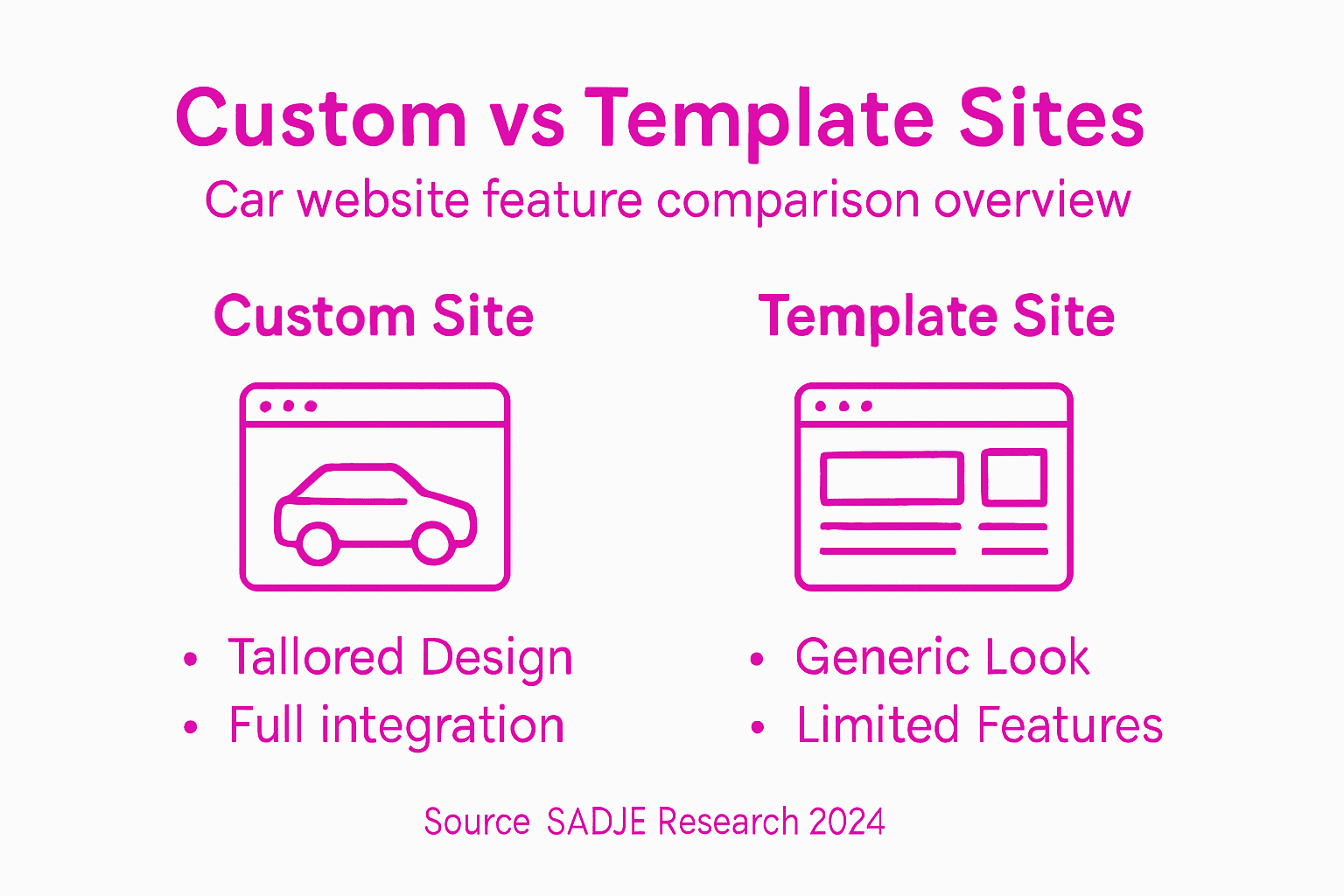
Custom websites cost more upfront. That’s the honest truth. But they deliver returns that templates simply cannot match, especially as your automotive business scales.
The Template Website Reality
Template sites work fine if you’re running a basic operation with minimal lead generation needs. You get a functional website quickly without large investment. Setup takes days rather than weeks.
But here’s where templates break down. Thousands of other automotive businesses use identical templates. Your site looks like your competitors’ sites. Your branding gets diluted because you’re forced to work within rigid design constraints.
Most critically, templates restrict what you can actually do. That booking system you want? Template doesn’t support it. The integration with your service management software? Not possible. Custom filters for vehicle inventory? Limited or unavailable.
Why Custom Sites Outperform Long-Term
Custom websites outperform templates by offering greater scalability, superior SEO performance, and tailored user experiences. Your site grows with your business instead of constraining it.
The performance difference shows across every metric that matters:
Search engine rankings – Custom sites are built with SEO in mind from day one, not patched on later
Lead capture capability – Your specific business workflows integrate seamlessly without workarounds
Brand differentiation – Your site genuinely reflects your garage or dealership, not a generic template
Flexibility for growth – New features, integrations, and tools can be added as your needs evolve
Unique customer experience – Every page optimised for how your specific customers shop and decide
Templates hit a ceiling. You cannot exceed what the template platform allows. Custom sites grow without limits.
The Cost Comparison That Matters
Yes, custom development costs more initially. A quality custom site from a specialist agency like SADJE requires investment.
But consider the actual numbers. A template site might cost £500 annually. A custom site might cost £5,000 upfront plus £1,000 annually. On paper, templates look cheaper.
Now consider results. If your custom site generates just five additional quality leads per month that convert to sales, the ROI covers your investment instantly. Most custom automotive sites exceed that benchmark significantly.
Template websites offer affordability. Custom websites offer growth. The difference becomes obvious within months when one site is generating leads whilst the other fights to stay visible.
Templates also create hidden ongoing costs. Every time you need something the template cannot do, you either hire developers to hack workarounds or compromise your vision. These costs compound.
Here is a summary of how bespoke and template automotive websites differ:
Aspect | Custom Website Advantage | Template Website Limitation |
Integration Flexibility | Tailored for business workflows | Limited or generic integrations |
Search Visibility | SEO embedded from inception | Often retrofitted and basic |
Customer Experience | Designed for target user journeys | One-size-fits-all navigation |
Scalability | Adapts with business growth | Constrained by platform structure |
Pro tip: Before committing to any platform, ask directly: can this site handle my lead volume, integrate with my existing tools, and remain competitive in search results three years from now? If the answer hesitates, you need custom development.
Costs, ROI, And Common Pitfalls
Custom automotive websites require genuine investment. You’ll spend more than a template solution. But understanding the actual costs, realistic ROI timelines, and common mistakes helps you make an informed decision and avoid costly errors.
Many garage owners hesitate because the upfront price stings. Then they realise that investing in custom development saves money long-term compared to fighting with templates or paying for endless workarounds.
What You’ll Actually Spend
Custom automotive website development costs vary based on complexity. A solid custom site for a UK garage or dealership typically ranges from £5,000 to £15,000 for initial build, depending on features and integrations.
This includes design, development, mobile optimisation, initial SEO setup, and basic lead capture integration. Annual maintenance and hosting costs roughly £1,000 to £3,000 depending on your provider and needs.
These aren’t arbitrary numbers. You’re paying for specialist developers who understand automotive sales workflows, not generic web developers working from templates.
When ROI Actually Happens
Return on investment is realised via improved user engagement, higher conversion rates, and stronger brand credibility. Most automotive businesses see measurable returns within three to six months.
Here’s how the maths work:
Month 1–3: Site launch, initial optimisation, search engine indexing begins
Month 3–6: Organic traffic increases, lead volume rises, conversion patterns emerge
Month 6+: Monthly leads typically exceed initial investment cost multiple times over
If your custom site generates ten additional qualified leads monthly at an average sale value of £2,000, you’ve recovered your investment. Most clients exceed this significantly.
Pitfalls That Kill ROI
Common mistakes waste time and money. Knowing them helps you avoid unnecessary costs:
Underestimating development timelines – Rushing launches creates bugs and missing features that require expensive fixes later
Neglecting mobile optimisation – Most automotive shoppers browse on phones; a site that fails on mobile loses 60% of potential customers
Failing to update content regularly – Search engines and customers punish stagnant sites; outdated inventory and static content kills visibility
Scope creep without planning – Adding features mid-project without clear priorities drives costs up and launches get delayed
Zero post-launch maintenance – Sites need ongoing updates, security patches, and optimisation to remain competitive
Avoiding common pitfalls requires clear goal-setting, professional project management, and consistent post-launch support to ensure sustainable growth.
The businesses that waste money on custom websites are those that treat them like one-time projects rather than ongoing investments that need care and attention to deliver results.
Your initial development cost is just the beginning. The ongoing optimisation and maintenance determine whether your site becomes a lead-generating machine or an expensive digital liability.
For reference, here are common pitfalls to avoid and their business consequences:
Mistake | Negative Outcome | How to Prevent |
Rushed launch | Bugs and missing features | Allow adequate development time |
Poor mobile usability | Lost mobile customer conversions | Prioritise mobile optimisation |
Neglected content updates | Declining search rankings | Update site regularly |
Unplanned feature creep | Budget and timeline overruns | Set clear priorities early |
No ongoing maintenance | Security vulnerabilities, outdated tools | Schedule continuous support |
Pro tip: Before signing any agreement, ask your provider exactly what happens after launch—specifically, how often they’ll optimise for performance, update your content strategy, and adjust your SEO tactics based on actual data from your site.
Unlock Your Automotive Business Potential with a Custom Website
The key challenge highlighted in the article is how generic websites fail to support the complex workflows and lead-generation needs of automotive businesses. Many garages and dealerships struggle with limited booking systems, poor mobile optimisation, and low-quality leads due to templated platforms that do not align with their unique selling points. Your goal is clear: drive more qualified enquiries, provide seamless customer experiences, and efficiently manage leads to boost sales and local visibility.
At SADJE, we understand these pain points deeply. Our bespoke automotive websites are purpose-built to solve these exact problems by integrating advanced features like 3D configurators, instant quote generators, and fully integrated booking systems. Designed with mobile-first SEO and analytics tailored specifically for UK automotive businesses, our solutions ensure your website becomes more than just an online presence—it becomes your most powerful digital salesperson.
Experience the difference a custom website makes in converting visitors into loyal customers. Explore how SADJE’s expertise can transform your business by visiting our website. Discover the full range of services and success stories that show how we help automotive companies increase web traffic and improve lead quality in our custom automotive website solutions.
Start your journey to growth today with a website that works perfectly for your unique business model.
Ready to leave behind generic templates and unlock true digital potential?
Take action now. Visit SADJE and get in touch to build a future-proof custom website designed to generate results for your automotive business.
Frequently Asked Questions
What are the key benefits of a custom automotive website?
Custom automotive websites offer tailored features that enhance user experience, improve lead generation, and boost search engine visibility. They incorporate specific functionalities like booking systems, quote generators, and customer engagement tools that generic templates lack.
How do custom websites improve lead generation for automotive businesses?
Custom websites are built with the specific needs of automotive businesses in mind, enabling seamless lead capture and management. They provide essential tools, such as integrated booking systems and custom filters, that make it easier for potential customers to interact and engage with your services.
Why is SEO important for custom automotive websites?
SEO is crucial as it helps increase the visibility of your website in search engine results. Custom websites are designed with SEO embedded from the start, ensuring that your business appears to customers searching for specific services, rather than relying on generic terms.
How does a custom website integrate with existing business workflows?
A custom website is designed to fit your business operations, allowing for integration with existing tools and processes, such as inventory management and customer relationship management systems. This minimises the need for manual data entry and streamlines your business operations.
Recommended
Comments