

Automotive Web Professionalism: Driving Trust and Results
- Feb 21
- 11 min read

What sets a trusted independent garage apart online is more than shiny graphics or fast-loading pages. For United Kingdom service managers, true professionalism means building genuine digital trust through clear information, credibility signals, and features customers expect when booking car services. Focusing on user-centric web design and lead-focused tools transforms your website into a powerful asset that demonstrates competence and actively wins new business.
Table of Contents
Key Takeaways
Point | Details |
Web Professionalism is Essential | A professional website builds customer trust and reflects your garage’s values and capabilities. |
User Experience Matters | Prioritise user-centric design with clear navigation, mobile optimisation, and instant booking systems to enhance engagement. |
Demonstrate Compliance | Show adherence to UK regulatory standards and display accreditations prominently to increase credibility. |
Regular Maintenance is Key | Conduct consistent audits and updates to ensure your website remains functional and relevant, avoiding common pitfalls that undermine professionalism. |
Defining automotive web professionalism for garages
Automotive web professionalism isn’t about having a flashy website. It’s about creating a digital space where customers feel confident enough to trust you with their vehicles.
For independent garages in the UK, web professionalism means your site reflects your business values and demonstrates genuine competence. When someone lands on your homepage, they should immediately understand what you offer and why they should book with you instead of the garage down the street.
The core pillars of automotive web professionalism include:
User-centric design – Navigation that makes sense, pages that load quickly, and information organised logically
Clear communication – Honest descriptions of services, transparent pricing, and straightforward contact options
Technical reliability – No broken links, outdated content, or slow-loading images that frustrate visitors
Trust signals – Customer testimonials, certifications, team photos, and genuine contact information
Mobile optimisation – Over 70% of searches happen on mobile devices; your site must work flawlessly on phones
Web professionalism also means aligning your online presence with specific business goals. Are you trying to reduce phone inquiries by offering online booking? Do you want to attract customers searching for specialist services like MOT testing or diagnostic work? Your website should actively support these objectives, not just exist passively.
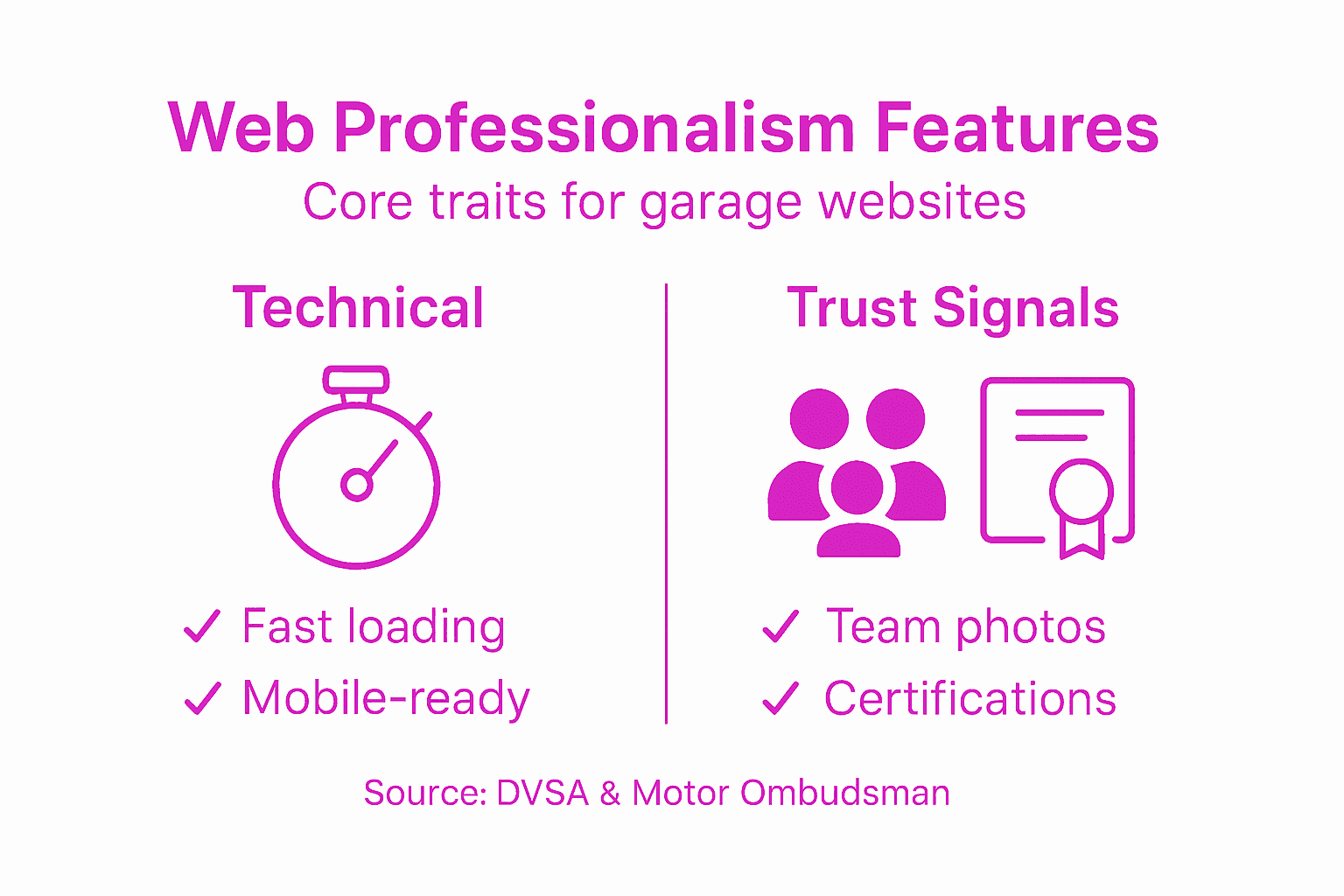
The technical foundation matters too. When customers visit, they’re making quick judgments about reliability based on visual design, page speed, and content quality. Poor typography, inconsistent branding, or outdated imagery send the wrong message—“This garage doesn’t invest in quality.”
User-centric design principles directly influence how garage customers interact with your site. Proper navigation structure, consistent colour schemes, and readable fonts aren’t luxuries—they’re expectations.
Automotive web professionalism also means embracing essential features that modern customers expect. Booking systems that let people schedule appointments at midnight. Quote generators that provide instant estimates. Service pages that answer the questions customers actually ask before calling.
Your website reflects your garage’s reputation. A professional site signals stability, competence, and respect for customer time. A neglected site signals the opposite, regardless of how skilled your mechanics are.
A professional garage website doesn’t just look good—it actively generates leads and converts visitors into loyal customers.
Pro tip: Audit your current site from a customer’s perspective: can someone find your phone number, book an appointment, and understand your services within 30 seconds? If not, your web professionalism needs work.
Here is a comparison of amateur versus professional garage websites and their effect on customer perception:
Aspect | Amateur Site Impact | Professional Site Impact |
First impressions | Erodes trust quickly | Immediately builds confidence |
Service clarity | Confusing or vague | Instantly understandable |
Booking process | Frustrating or incomplete | Smooth and instant |
Branding consistency | Mixed logos and colours | Clear, unified appearance |
Conversion likelihood | Visitors exit without action | Visitors book or inquire |
Key features of professional automotive websites
A professional garage website isn’t about aesthetics alone. It’s a tool that works for you 24/7, turning curious visitors into paying customers while you’re closed.
Modern customers expect specific functionality when they land on your site. They want to check your services, see your prices, and ideally book an appointment without picking up the phone. If you can’t deliver these basics, they’ll visit your competitor instead.
The essential features every professional garage website needs:
Mobile-first responsive design – Your site must work flawlessly on phones, tablets, and desktops
Clear service descriptions – Each service should have its own page explaining what you do and why customers need it
Online booking system – Let customers schedule appointments at 2am if they want to
Transparent pricing – Display labour rates, service costs, and any diagnostic fees upfront
Customer testimonials – Real reviews from real customers build credibility instantly
High-quality photos – Show your workshop, your team, and the work you do
Live chat support – Answer questions immediately when someone visits your site
Service scheduling integration – Connect your booking system to your actual workshop calendar
Interactive tools like quote generators and trade-in estimators transform passive visitors into engaged prospects. When someone can see an instant estimate for their MOT or service, they’re more likely to proceed rather than calling three other garages.
Responsive design deserves special attention. Over 60% of garage website visitors browse on mobile phones. A site that works beautifully on desktop but looks broken on mobile loses customers immediately.

Trust signals matter enormously for independent garages. Your team photos, certifications, years in business, and customer reviews all signal legitimacy. A faceless, generic website suggests you might be operating from a garden shed.
Seamless vehicle search and inventory management capabilities help customers find exactly what they’re looking for without frustration. Clear navigation between services, pricing, and booking options keeps people moving forward rather than bouncing away.
CRM integration ties everything together. Your booking system should feed directly into your customer database, eliminating double-entry and ensuring nothing falls through the cracks.
The difference between a professional garage website and an amateur one isn’t fancy design—it’s whether it actually converts visitors into bookings and revenue.
Pro tip: Test your website on an iPhone right now. Can you find a service, see the price, and book an appointment in under two minutes? If not, you’re losing customers every single day.
Types of web tools for lead generation
Lead generation tools are the difference between a website that looks nice and a website that actually makes money. For independent garages, the right tools transform casual browsers into qualified prospects you can follow up with.
Not all leads are equal. A customer actively searching for an MOT right now is worth far more than someone casually browsing your homepage. Your tools need to capture both types and help you prioritise who to contact first.
The core categories of lead generation tools include:
Booking and scheduling systems – Capture appointments directly without phone tag
Quote generators – Let customers request instant estimates for services
Contact forms – Simple, effective ways to collect inquiries and contact details
Live chat – Engage visitors in real time and answer questions immediately
CRM systems – Organise all your leads and automate follow-ups
Email marketing platforms – Stay in touch with prospects who aren’t ready to book yet
Landing pages – Targeted pages designed specifically to convert one type of visitor
Online booking systems are your 24/7 receptionist. A customer who can schedule their own appointment at 11pm on a Sunday might have gone to a competitor if forced to call during business hours. Every booking you capture digitally is a lead you’ve already partially converted.
Quote generators and calculators work brilliantly for garages. When someone enters their vehicle registration and selects a service, they immediately see a price estimate. This transparency builds trust and qualifies the lead—they’ve already decided the price is acceptable.
CRM systems and marketing automation platforms handle the backend work that separate amateurs from professionals. They track every interaction, score leads by interest level, and remind you to follow up before a prospect forgets about you.
Live chat support captures leads who are ready to buy but have one final question. Without it, they bounce away and contact your competitor instead. Response time matters enormously—answer within two minutes and conversion rates spike dramatically.
Multi-channel lead capture strategies incorporating SEO, social media, and CRM integration ensure you’re reaching prospects wherever they are. One customer finds you through Google, another through Facebook, a third through a referral. Your tools must collect them all into one system.
Email follow-up sequences nurture warm leads automatically. Someone who requested a quote but didn’t book receives reminder emails over the next week. Most conversions happen on the third or fourth contact, not the first.
The best lead generation tool is worthless if you don’t follow up within minutes. Speed matters more than sophistication.
Pro tip: Audit your current lead capture right now. When someone requests a quote or books an appointment, can you respond within 30 minutes? If not, you’re losing sales to garages that do.
The following table summarises lead generation tool categories and their direct business benefit for UK garages:
Lead Tool Type | Main Function | Business Advantage |
Booking system | Automates appointment setting | Reduces calls, increases bookings |
Quote generator | Instant service estimates | Qualifies leads and builds trust |
CRM integration | Organises client data | Streamlines follow-up, boosts retention |
Live chat | Real-time question resolving | Converts hesitant visitors quickly |
Industry standards and compliance for UK garages
Compliance isn’t boring bureaucracy. It’s the foundation that separates professional garages from dodgy operations. When your website demonstrates you follow UK standards, customers instantly trust you more.
UK garages operate within a strict regulatory framework. The DVSA, Environmental Agency, and Health and Safety Executive all have rules you must follow. Your website should reflect this professionalism by being transparent about your certifications and accreditations.
Key compliance areas every UK garage must address:
Vehicle maintenance systems – Documented procedures for inspections and servicing
Defect reporting – Legal obligations to report safety-critical defects discovered during work
Environmental compliance – Proper handling of waste oil, fluids, and hazardous materials
Staff training records – Proof that mechanics hold relevant qualifications and certifications
Customer communication – Clear documentation of work authorised and estimates provided
Data protection – GDPR compliance for customer information collected via your website
Health and safety – Safe working conditions in your workshop documented and enforced
DVSA roadworthiness standards and vehicle maintenance requirements outline legal obligations for garages maintaining commercial and passenger vehicles. These standards cover inspection frequencies, defect categories, and reporting procedures that directly impact how you operate.
Accreditation schemes add genuine credibility. The Motor Ombudsman’s “Trust My Garage” scheme demonstrates your commitment to fair business practices and quality workmanship. CTSI-approved codes of practice for garages require regular audits and transparent customer dealings, giving customers real assurance.
Your website plays a compliance role too. Display your accreditations prominently. Show your team’s qualifications. Be transparent about warranties on work completed. These signals reassure customers you’re not cutting corners.
GDPR matters more than many garages realise. Every time someone submits a booking form or quote request, you’re collecting personal data. Your website must have clear privacy policies explaining how you use this information. Breaches can result in substantial fines.
Environmental compliance affects your reputation. If customers discover you’re disposing of oil improperly, your professional image collapses instantly. Document proper procedures and mention them on your website.
Compliance is marketing. Every regulation you follow becomes a trust signal you can communicate to customers.
Pro tip: Conduct a compliance audit right now: does your website display your accreditations, team qualifications, and privacy policy clearly? If customers can’t verify your credentials in 30 seconds, add them immediately.
Common pitfalls and risk mitigation strategies
Many garages build professional websites then sabotage themselves through preventable mistakes. Understanding common pitfalls—and how to avoid them—separates thriving online presences from abandoned digital afterthoughts.
The biggest mistake is treating your website as a one-time project rather than an ongoing system. Launch it, forget it, watch it slowly decay into irrelevance. Outdated content, broken links, and stale testimonials scream “this garage isn’t serious about online presence.”
Common pitfalls that damage professional credibility:
Neglected content – Service pages that haven’t been updated in years with prices from 2019
Broken booking systems – Customers can’t actually complete appointments or receive confirmation emails
Poor mobile experience – Site works on desktop but looks broken on phones
Missing contact information – Phone number buried or outdated, creating friction for interested prospects
Slow page load times – Visitors abandon slow sites within 3 seconds, destroying conversion rates
No trust signals – Missing testimonials, team photos, or accreditation badges
Inadequate security – No SSL certificate, exposing customer data to risk
Inconsistent branding – Logos, colours, and messaging that don’t align across pages
Risk mitigation starts with proactive identification. Systematic approaches to identifying and assessing risks apply directly to web professionalism. Document what could go wrong, assess the likelihood, and prioritise fixes accordingly.
Create a maintenance schedule. Monthly audits catch broken links before customers do. Quarterly content reviews keep service descriptions and pricing current. Annual security assessments protect customer data and your reputation.
Implement monitoring systems. Tools that alert you when your site goes down, pages load slowly, or forms stop working prevent disasters. You’ll fix problems before customers encounter them.
Integrated risk management strategies incorporating compliance and cybersecurity standards ensure your website protects both your business and customer information. GDPR compliance, SSL encryption, and regular backups aren’t optional extras—they’re essential safeguards.
Document everything. When you make changes, update your documentation. This prevents the common scenario where staff members don’t understand how systems work and accidentally break something critical.
Test thoroughly before launching changes. A broken quote generator during your busiest season costs real money. Staging environments let you catch problems safely.
The cost of preventing problems is always lower than the cost of fixing them after customers experience them.
Pro tip: Assign one team member responsibility for website maintenance monthly. Set calendar reminders to check that booking systems work, links function, and contact information is current. Fifteen minutes monthly prevents months of damage.
Elevate Your Garage’s Online Presence with Expert Automotive Web Solutions
The article highlights the critical challenge of transforming your website from a mere digital presence into a powerful tool that builds trust and generates quality leads for your garage. Many UK independent garages struggle with outdated content, poor mobile optimisation, and ineffective booking systems that frustrate visitors and lose business. If you want to overcome these pitfalls and implement features like online booking, instant quote generators, and trustworthy testimonials, you need a partner who understands the automotive industry’s unique demands.
SADJE specialises in creating bespoke, high-performance websites tailored specifically for garages and automotive service providers. With advanced lead generation tools, seamless CRM integration, and expert SEO management, you can confidently convert visitors into loyal customers. Discover how a professional website can drive results and reflect your business values on SADJE’s landing page.
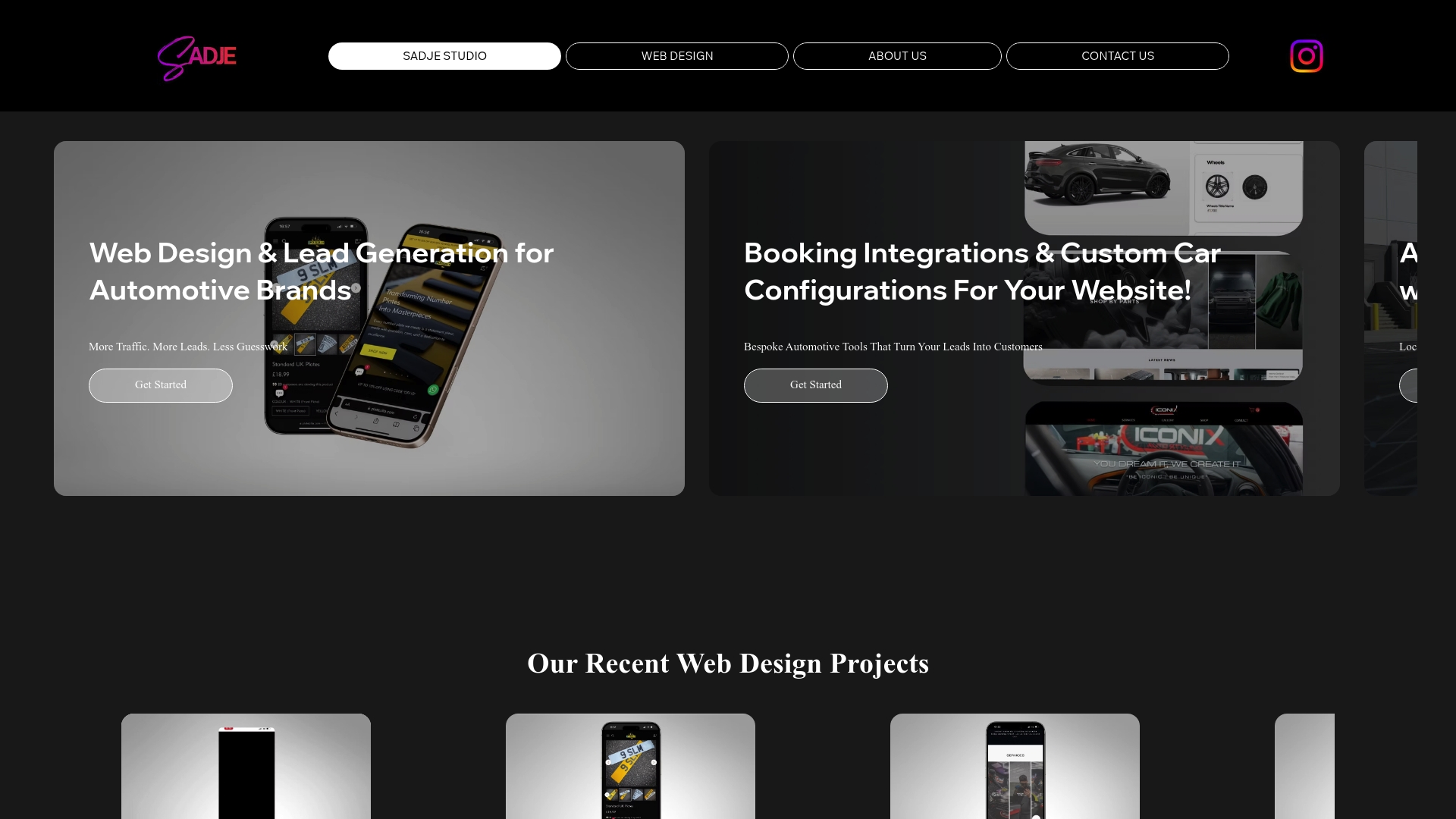
Don’t let poor web professionalism hold your garage back. Take the next step towards digital growth by exploring our tailored automotive web development solutions. Visit https://sadje.co.uk today to book a free consultation and start turning your website into a trusted lead-generating machine.
Frequently Asked Questions
What is automotive web professionalism?
Automotive web professionalism is the quality and effectiveness of a garage’s online presence. It involves creating a website that reflects the business’s values, communicates services clearly, and provides a user-friendly experience to build customer trust.
Why is mobile optimisation important for garage websites?
Mobile optimisation is crucial because over 60% of visitors browse garage websites on mobile devices. A site that functions well on phones ensures potential customers can easily navigate, book services, and view information, reducing the likelihood of losing them to competitors.
How can I improve the lead generation on my garage website?
To enhance lead generation, include features such as a booking system for appointments, a quote generator for instant service estimates, contact forms for inquiries, and live chat support to engage visitors in real time.
What are trust signals and why are they important for a garage’s website?
Trust signals include customer testimonials, certifications, and team photos that establish credibility. They are important because they assure potential customers of the garage’s professionalism and reliability, increasing the likelihood of converting visitors into clients.
Recommended
Comments