

Automotive Web Design: Powering Digital Growth
- Feb 22
- 10 min read
Many UK garage owners and dealership managers find a simple website is no longer enough to win customer trust. In a market where customers research online before setting foot in your business, your web presence is the digital showroom visitors judge first. A strong automotive web design does more than look good—it offers a user-focused experience, clear navigation, and real-time inventory that convert interest into action, giving your business a competitive edge right from the first click.
Table of Contents
Key Takeaways
Point | Details |
User-Focused Design | Ensure your website is intuitive and easy to navigate, catering to customer needs efficiently. |
Professional Presentation | Showcase your vehicles and services attractively to build trust and enhance credibility in the market. |
Real-Time Integration | Implement tools that provide accurate inventory updates and booking systems to improve customer experience and engagement. |
Responsive Design | Optimise the site for all devices to capture the majority of traffic, as many customers search for services on mobile. |
Defining Automotive Web Design and Its Purpose
Automotive web design is far more than just building a website for your garage, dealership, or rental company. It’s about creating a digital space that reflects your business’s core offerings whilst meeting the specific needs of your customers in a competitive market.
At its heart, automotive web design combines three essential elements:
User-focused design that makes browsing intuitive for potential customers
Professional presentation that showcases your vehicles, services, and expertise
Digital integration that supports bookings, enquiries, and customer engagement
Your website acts as a digital showroom. Unlike a physical location with fixed opening hours, it works for you 24/7, presenting your inventory and services to customers searching online. This permanence matters—customers often research dealers and garages before visiting in person.
The purpose of automotive web design stretches beyond aesthetics. A well-designed automotive website facilitates online sales and bookings whilst enhancing your brand recognition within your local market. For UK-based automotive businesses, this means capturing customers at the exact moment they’re searching for your services.
Your website bridges the gap between what you offer and what customers can actually access online. Many businesses invest in their physical premises, stock, and staff—but without a professional web presence, potential customers never get to see what you’ve built.
Key purposes your automotive website should achieve:
Create a positive first impression before customers visit physically
Showcase products and services with high-quality visuals
Enable customers to request quotes, book appointments, or check inventory instantly
Build trust through professional presentation and customer reviews
Improve local visibility so customers searching “garage near me” find you
The digital marketplace is competitive. Your customers are comparing you with competitors online before making decisions. A properly designed automotive website doesn’t just exist—it actively works to convert browsers into enquiries and bookings.
Your website is often the first touchpoint between your business and a potential customer. Make it count.
In today’s market, automotive businesses without a professional web presence simply lose ground. Whether you operate a garage, dealership, or rental company, your website directly impacts how customers perceive your professionalism and reliability.
Pro tip: Audit your current website’s speed and mobile experience—these two factors alone determine whether customers stay to explore or bounce to competitors. Test on real devices, not just desktop browsers.
Key Elements in Automotive Website Development
Building an effective automotive website requires understanding which components actually drive customer engagement and sales. Not every feature matters equally—some elements directly impact whether visitors become enquiries, whilst others merely look good.
The foundation starts with high-quality vehicle imagery from multiple angles. Customers want to inspect cars thoroughly before contacting you. Poor photos signal poor standards. Invest in professional photography or 360-degree virtual showroom capabilities that let buyers explore vehicles properly.
Navigation must be intuitive. Customers searching your site should find vehicles, services, pricing, and booking options without frustration. Confusing layouts kill conversions—users leave within seconds if they can’t find what they need.
Core elements every automotive website requires:
Responsive design that works flawlessly on mobile, tablet, and desktop
Clear pricing transparency to build immediate trust with visitors
Customer testimonials and reviews that provide social proof
Real-time inventory management showing current stock accurately
Booking and enquiry systems enabling instant customer action
Defining your target audience shapes everything else. A luxury dealership needs different features than a high-volume used-car garage. Understanding who you’re trying to reach means building specifically for their needs rather than copying competitor websites.
Interactive tools like virtual showrooms and financing calculators separate serious operators from basic competitors. These elements reduce friction—customers can visualise purchases and understand affordability before contacting you.
SEO optimisation isn’t optional. Your website must rank locally so customers searching “MOT centre near me” or “used cars in [your town]” actually find you. Technical SEO, local keywords, and proper structure determine visibility.
Your website’s architecture shapes user experience. Plan it intentionally, not as an afterthought.
Integrating real-time data matters more than aesthetics. If your inventory system updates automatically, customers see current stock. Manual updates create frustration when customers contact you about sold vehicles.

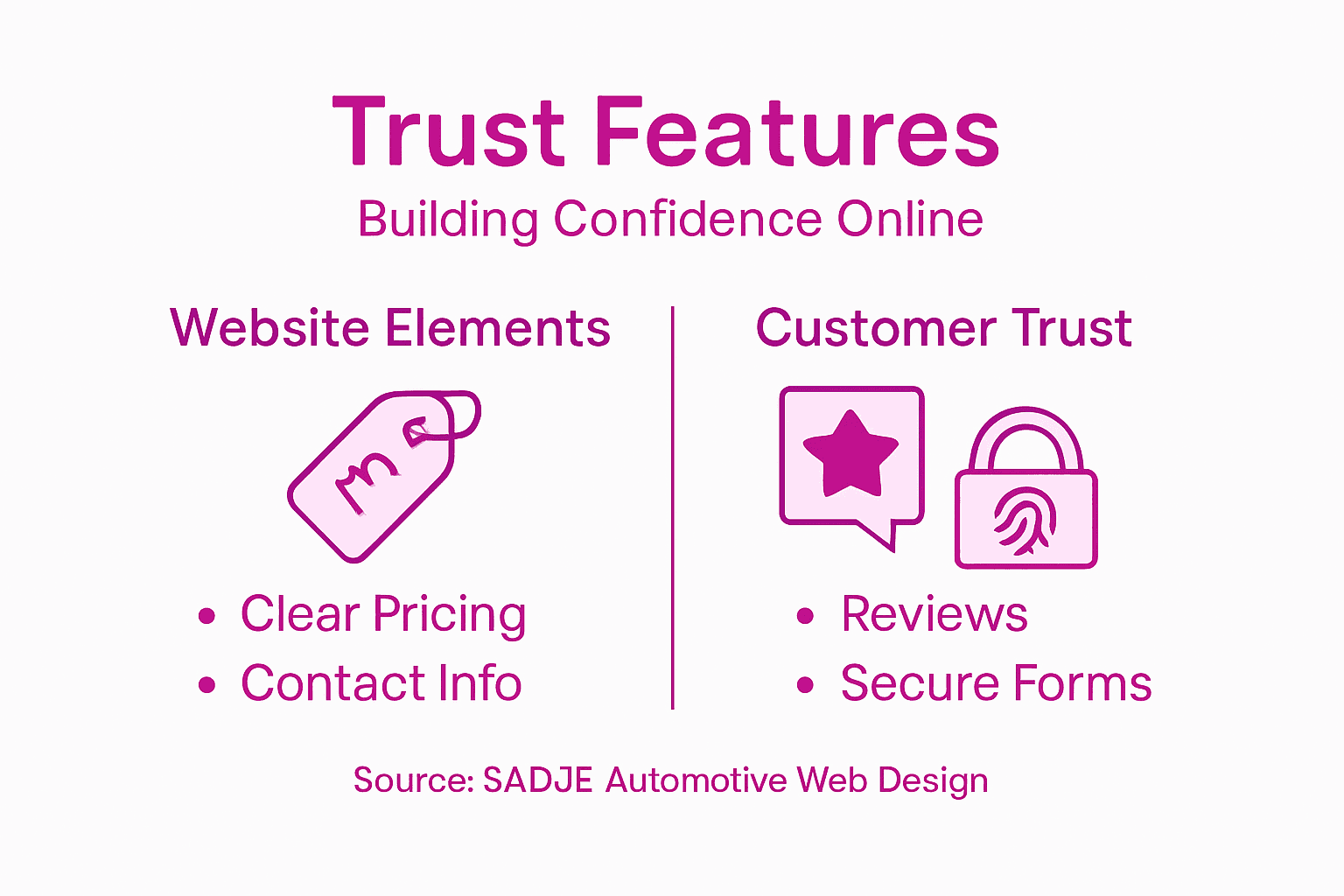
Trust-building features work harder than flashy graphics. Transparent pricing, clear contact information, genuine reviews, and professional presentation convert browsers into buyers far more effectively than animation or trendy design.
Here’s a comparison of essential versus advanced features for automotive websites and their business impact:
Feature Type | Example Feature | Customer Benefit | Business Impact |
Essential | Responsive design | Seamless browsing on any device | Wider reach and better engagement |
Essential | Real-time inventory updates | Accurate vehicle availability | Builds trust and credibility |
Advanced | 3D vehicle configurator | Personalised car exploration | Higher lead qualification |
Advanced | Integrated CRM | Faster, tailored follow-up | Improved sales conversion rates |
Pro tip: Start with your three most important customer actions—perhaps “view inventory,” “request a quote,” and “book a service”—then ensure these are frictionless. Everything else is secondary.
Advanced Tools: Configurators, Booking, and Leads
Basic websites display inventory. Advanced automotive websites convert browsers into paying customers through intelligent tools that reduce friction at critical decision points. These tools separate thriving dealerships from struggling competitors.
3D Configurators let customers build their ideal vehicle before contacting you. Instead of imagining specifications, they interact with a 360-degree interactive car configurator showing exact colours, trim levels, and features. This immersive experience increases confidence and reduces enquiry uncertainty.
Customers visualising their perfect car are far more likely to contact you seriously. They’ve already committed mentally to the purchase—your job becomes easier because they’re pre-qualified.
Tools that actually drive conversions:
Car configurators with zoom and 360-degree views for detailed exploration
Vehicle comparison tools letting customers evaluate models side-by-side
Test drive booking systems that capture appointments instantly without phone calls
Cost calculators showing finance options, trade-in values, and monthly payments
Diagnostic booking for servicing appointments with instant confirmation
Booking systems matter more than most businesses realise. When customers can book a test drive or service appointment instantly on your website, you capture them immediately. Phone calls require staff availability—online booking works at 3 AM on Sunday when your customer finally decides.
Lead management integration closes the loop. CRM and lead management systems track customer interactions automatically, showing your team who browsed what, which configurator they used, and whether they started a booking. This intelligence lets you nurture prospects effectively rather than hoping they call back.
Tools without integration are just features. Tools connected to your CRM become a lead-generation engine.
When a customer uses your configurator, that action signals intent. Your system captures their choice, and your team follows up strategically. Without integration, that valuable signal disappears.
Financing calculators deserve special attention. Many customers abandon purchases because they don’t understand affordability. Show them monthly payments instantly and barriers dissolve. They can explore “what if” scenarios—different deposit amounts, term lengths, vehicle specifications—all instantly.
Test drive booking reduces friction at the critical conversion moment. Rather than customers leaving your site to phone later, they book immediately. You confirm the appointment automatically, and they arrive prepared.
Pro tip: Start with one advanced tool—typically a vehicle configurator or booking system—rather than overwhelming your site. Master it completely, integrate it with your CRM, and track results rigorously before adding additional tools.
Boosting Customer Engagement and Conversion Rates
Engagement and conversion are different things. Engagement means customers interact with your site. Conversion means they take action—requesting quotes, booking appointments, or making purchases. You need both, but conversion is what matters financially.
Speed kills hesitation. When customers enquire, they’re in a decision-making mood. Respond within hours, not days. Quick response times significantly boost lead conversion rates because momentum matters—delay and they contact competitors instead.
Personalised communication outperforms generic messages. Don’t send the same email to everyone. Reference the specific vehicle they viewed, the service they enquired about, or the trade-in they mentioned.
Multi-channel communication increases conversion probability:
Phone calls for immediate conversations and relationship building
WhatsApp messaging for quick responses customers appreciate
Email for documentation and detailed information
Text messages for appointment reminders and urgency
Live chat on your website for instant engagement
Customers research extensively before contacting you. They’ve already decided whether they’re interested—your job is removing doubt. Address their specific concerns based on what they viewed and enquired about.
Model-specific offers dramatically improve conversion. Generic discounts feel weak. Instead, offer “£500 extra on your trade-in for this Volkswagen Golf model” or “Free servicing for two years on this specific vehicle.” Specificity signals genuine value.
Trust builds when customers feel understood, not when they feel like they’re being sold to.
Personalisation builds trust faster than generic marketing ever could. When you reference their specific interests and needs, they know you’ve paid attention. They’re more likely to become loyal customers, not just one-time buyers.
Follow-up sequences matter enormously. First contact captures initial interest. Second contact within 24 hours reinforces that interest. Third contact personalised to objections converts hesitant prospects into buyers. Most businesses stop after one contact.
Timing your follow-up strategically increases effectiveness. Contact them when they’re most likely to engage—typically evenings and weekends for personal vehicle purchases, business hours for fleet enquiries.
Automated systems can’t replace personal touch. Use automation to trigger timely reminders, but craft personalised messages within those sequences. Show customers you remember their preferences and priorities.
Pro tip: Train your team to respond to enquiries within two hours during business hours—this single behaviour change typically increases conversion rates by 15-25 per cent before any other optimisations.
Common Pitfalls in Automotive Web Projects
Most automotive websites fail silently. They look professional, sit online for months, and generate almost nothing. The problem isn’t usually appearance—it’s invisible mistakes that kill conversions before customers even notice.
Design without purpose destroys results. Businesses obsess over aesthetics—beautiful imagery, trendy layouts, sophisticated colour schemes—whilst ignoring whether customers can actually find information. Focusing excessively on aesthetics rather than usability reduces lead generation efficiency dramatically because pretty websites don’t convert.
Mobile abandonment is financial suicide. Approximately 60 per cent of automotive searches happen on phones. If your site breaks on mobile devices, you’ve eliminated your largest audience immediately. Responsive design isn’t optional—it’s survival.
Common mistakes that destroy performance:
Outdated inventory information making customers distrust your stock accuracy
Poor site navigation forcing visitors to dig through menus looking for vehicles
Missing clear calls-to-action leaving customers unsure how to enquire or book
Slow page loading causing impatient visitors to bounce to competitors
Weak security features making customers hesitant to submit personal information
Page speed matters more than most businesses realise. Overlooking page speed affects both SEO rankings and user engagement because slow sites frustrate visitors and search engines alike. Test your site’s speed on real mobile connections—not just your office broadband.
Inventory data requires constant maintenance. Displaying sold vehicles or outdated pricing destroys credibility instantly. Customers see false information and assume everything else on your site is unreliable.
Beautiful design fails silently. Users don’t complain—they simply leave.
Security oversights create customer hesitation. If customers worry their personal information isn’t protected, they won’t submit enquiries. Install proper SSL certificates, display trust badges, and communicate security clearly.
Navigation confusion kills conversions at the critical moment. Customers know what they want—a specific vehicle model, a service type, or pricing information. Make it accessible within three clicks maximum.
Weak calls-to-action leave money on the table. “Click here” doesn’t work. “Request a quote for this Golf,” “Book your MOT now,” or “View financing options” give customers clear direction.
The table below summarises the top pitfalls in automotive web projects and their likely consequences:
Common Pitfall | User Impact | Business Consequence |
Slow page loading | Frustration and site abandonment | Drops in SEO and lead loss |
Poor mobile experience | Difficult navigation on phones | Missed majority of potential leads |
Outdated inventory | Mistrust of site information | Damaged reputation, fewer enquiries |
Weak calls-to-action | Unclear next steps for visitors | Lower booking and quote requests |
Pro tip: Test your website weekly from a mobile phone on 4G connection, not WiFi. This single practice catches most user experience problems before they cost you sales.
Transform Your Automotive Business with Expert Web Solutions
The article highlights how critical a professionally designed automotive website is to bridging the gap between your business offerings and customer expectations. Key challenges include creating user-friendly navigation, ensuring real-time inventory updates, integrating advanced tools like 3D configurators and booking systems, and boosting local SEO to increase visibility. If your current website lacks responsive design, seamless customer engagement features, or quick lead conversion mechanisms, your business is likely missing valuable opportunities.
At SADJE, we specialise in addressing these exact pain points. By crafting bespoke automotive websites tailored for garages, dealerships, and rental firms, we equip you with next-generation digital tools to elevate customer experience and streamline enquiries instantaneously. From integrating interactive configurators to managing paid advertising and SEO plugins, our solutions drive quality leads, improve your online professionalism, and maximise your outreach in a competitive UK market.
Discover how SADJE can power your digital automotive growth today.
Ready to leave slow-loading, outdated websites behind? Take the first step towards a high-performance automotive website that converts browsers into loyal customers. Contact SADJE now to see how our expert team can transform your online presence and accelerate your business growth.
Frequently Asked Questions
What is automotive web design?
Automotive web design involves creating websites specifically tailored for garages, dealerships, and rental companies, aiming to reflect their core offerings while providing an intuitive user experience for customers.
Why is a responsive design important for an automotive website?
Responsive design ensures that your website works flawlessly on various devices, such as mobiles, tablets, and desktops, providing users with a seamless browsing experience, which is critical given that a significant portion of automotive searches are conducted on mobile.
How can high-quality images impact my automotive website’s effectiveness?
High-quality images from multiple angles can enhance user trust and engagement, as customers often want to thoroughly inspect vehicles before contacting you. Poor images can signal low standards and negatively impact conversions.
What features should be included in an effective automotive website?
Key features should include responsive design, real-time inventory updates, clear pricing transparency, customer testimonials, and easy booking and enquiry systems to facilitate instant customer actions.
Recommended
Comments