

6 Essential Website Features for Car Dealers' Success
- Feb 25
- 14 min read

You know how challenging it can be to attract buyers and keep their interest on your dealership website. Without the right tools, visitors leave before making an enquiry or booking a test drive, and valuable leads slip through unnoticed. The competition is fierce—dealerships with modern, user-friendly sites and integrated digital solutions are capturing the attention of serious buyers every day.
This list gives you practical strategies backed by proven technology and research. You’ll discover how to make your website more engaging, capture better leads, and provide a smoother experience that turns casual browsers into committed customers. Get ready for actionable ideas that address real obstacles and help your dealership grow.
Each insight offers a clear benefit, from boosting lead conversion with AI-powered tools to improving user satisfaction through responsive design and online booking. See what works for successful dealers and learn how to put these features to use, so you never miss a sale again.
Table of Contents
Quick Summary
Key Message | Explanation |
1. Ensure responsive design for your website | A mobile-friendly website is crucial as mobile traffic accounts for over 60% of visits in the automotive sector. |
2. Integrate lead generation tools effectively | Centralising lead data helps improve follow-up and response rates, leading to increased conversions. |
3. Implement online booking systems | Allow customers to schedule appointments anytime to enhance customer satisfaction and booking rates. |
4. Use dynamic vehicle listings with filters | Simplifying the search process helps customers quickly find relevant vehicles, reducing bounce rates. |
5. Optimise for SEO and use analytics | Ranking well on search engines increases visibility, and analytics provide insights into customer behaviour and preferences. |
1. Responsive design for seamless browsing
Your dealership website must work flawlessly across every device. Tablets, smartphones, and desktop computers all deserve a polished, functional experience.
Responsive design automatically adjusts your website’s layout based on screen size. This means customers viewing your inventory on their mobile whilst commuting see the same professional presentation as someone browsing on their office desktop.
Why does this matter for car dealers? Mobile traffic accounts for over 60% of website visits in the automotive sector. If your site looks broken or functions poorly on phones, potential buyers simply move to a competitor’s site.
Here’s what responsive design accomplishes for your dealership:
Improves user experience across all devices without maintaining separate websites
Reduces bounce rates when customers access your site from their phones
Boosts search engine rankings since Google prioritises mobile-friendly sites
Simplifies website management with one codebase instead of multiple versions
Increases lead conversion by ensuring smooth browsing and easy form submissions
Customers expect seamless experiences on their devices—anything less signals unprofessionalism and costs you sales.
When a potential buyer clicks through from a Google search result on their smartphone, they should immediately see vehicle listings in an organised, easy-to-browse format. Images should load quickly without requiring pinching and zooming. Buttons for contacting you or scheduling test drives should be large enough to tap without frustration.
Responsive web design matters significantly for automotive dealers because it directly influences how prospects interact with your offerings. A dealership with a responsive site appears modern and trustworthy, whilst one with a dated, non-responsive design suggests the business hasn’t invested in staying current.
Test your current site yourself. Open it on your smartphone and navigate through your vehicle inventory. Does it feel intuitive? Can you read the text without zooming? If you’re squinting or frustrated, your customers are too.
Professional tip: Run your website through Google’s Mobile-Friendly Test tool regularly to identify responsive design issues before they impact your customer experience and search rankings.
2. Integrated lead generation tools
Without proper lead capture systems, your dealership leaves money on the table daily. Visitors browse your inventory and disappear without you ever knowing who they were.
Integrated lead generation tools automatically capture customer information across multiple touchpoints. Web forms, phone enquiries, chat interactions, and email sign-ups all feed into one centralised system where your sales team can act immediately.
Why integration matters more than scattered systems? When leads arrive through different channels but aren’t connected, follow-up becomes chaotic. One salesperson might contact a prospect whilst another does the same, creating a poor customer experience and wasting your team’s time.
Here’s what modern lead generation integration provides:
Unified customer data from all website interactions in one accessible location
Automated lead scoring that identifies serious buyers versus casual browsers
Instant notifications so your team responds whilst prospects are still interested
Simplified follow-up workflows that reduce missed opportunities
Real-time insights into which marketing campaigns generate the highest-quality leads
When every lead reaches the right salesperson at the right moment, your conversion rates climb dramatically.
Consider how leads flow through your system currently. A customer fills out a form requesting a quote. Another calls your showroom. A third completes a vehicle comparison on your site. Without integration, these three enquiries might sit in different systems, and your team might take hours to consolidate and prioritise them.
Integrated systems use AI-powered lead scoring to rank prospects by engagement level. A buyer who has visited your site multiple times, viewed specific vehicle details, and completed a contact form rates higher than someone who clicked once and left. Your sales team focuses on high-probability opportunities first, maximising their time and improving closing rates.
Modern integrated tools also enable personalised communication at scale. The system remembers that a customer viewed three diesel estate cars last week, so when you follow up, your message references those specific vehicles rather than sending generic inventory updates.
Building effective automotive lead generation strategies means ensuring every tool in your marketing stack communicates with your lead management system. Email platforms, your website, CRM software, and phone systems should all feed customer information into one central hub.
Professional tip: Set up automated lead distribution rules so qualified enquiries route instantly to available salespeople based on their specialisation, location, or current workload—this dramatically reduces response time and improves conversion.
3. Online booking and instant quoting systems
Your customers want immediate answers without waiting for a callback. If they can’t book a test drive or get a price quote at midnight on Sunday, they’ll find a dealership that offers it.
Online booking systems let customers schedule test drives, service appointments, and consultations directly through your website whenever suits them. No phone tag. No email delays. Just instant confirmation and automatic reminders.
Instant quoting tools provide vehicle prices and financing options in real-time based on what customers select. Instead of submitting forms and waiting days for a response, they see numbers immediately and decide whether to proceed.
Why does availability matter? Your competitors are open 24/7 online. If your dealership requires customers to call during business hours for basic information, you lose leads to dealers offering self-service options.
Here’s what these systems accomplish:
Eliminate double bookings and scheduling conflicts automatically
Reduce administrative overhead by removing manual appointment entry
Increase test drive bookings by removing friction from the process
Generate qualified leads at any time, not just during office hours
Improve customer satisfaction through instant confirmation and reminder notifications
Provide real-time availability without staff involvement
Customers who can book immediately are more likely to follow through than those who must wait for a salesperson to respond.
Consider the typical customer journey. A prospect visits your site at 10 PM on a Wednesday evening. They find a vehicle they like and want to see it tomorrow. Without online booking, they note your phone number and forget by morning. With integrated booking, they schedule the appointment right then, receive confirmation via email and SMS, and show up the next day ready to buy.
Online scheduling systems reduce operational costs significantly whilst preventing missed opportunities. Your showroom runs more smoothly when staff know exactly when customers are arriving. You can assign specific salespeople to appointments, prepare vehicles in advance, and manage your floor efficiently.
Instant quoting goes further by letting customers explore financing options independently. They can see how different down payments affect monthly costs, whether particular vehicles fit their budget, and what they’d owe with various trade-in values. This transparency builds trust and qualifies leads before they contact you.
Professional tip: Integrate your booking and quoting systems with your CRM so appointment data feeds directly into customer profiles, allowing salespeople to see what vehicles the customer viewed and what quotes they received before the test drive appointment.
4. Dynamic vehicle listings with search filters
A customer visits your site looking for a five-door family saloon under £15,000 with low mileage. If your listings don’t let them filter by these criteria, they’ll click through dozens of irrelevant vehicles and leave frustrated.
Dynamic vehicle listings display your inventory in real-time and allow buyers to narrow down options by make, model, price range, mileage, transmission, fuel type, and features. Instead of scrolling endlessly, they find exactly what they want within seconds.
Advanced search filters anticipate what customers are looking for and reduce what’s called cognitive load. A buyer doesn’t need to think hard about how to find vehicles matching their criteria. The filters make it obvious.
Why does this matter for your dealership? Every second a customer spends searching without finding relevant vehicles increases the likelihood they’ll abandon your site. They’re comparing you to other dealers right now, and competitors with better search functionality win those sales.
Here’s what effective dynamic listings accomplish:
Help customers find suitable vehicles in seconds rather than minutes
Reduce bounce rates by showing only relevant inventory
Increase time spent on your site as visitors explore filtered results
Provide real-time accuracy so customers don’t enquire about sold vehicles
Enable customers to save searches and receive alerts for matching vehicles
Improve mobile experience by simplifying navigation on smaller screens
When customers can filter your inventory instantly, you transform browsers into qualified leads.
Consider how your inventory displays currently. If customers see all 200 vehicles listed on one page with no way to filter, they’ll abandon the experience. If searching takes multiple clicks to set filters and results are slow to load, you’ve lost their attention.
Modern dealership websites use API technology to keep vehicle listings constantly updated. When a vehicle sells, it disappears from search results immediately. When new stock arrives, it appears without manual intervention. This automation ensures accuracy and prevents the frustration customers feel when they enquire about vehicles that are already sold.
Effective filtering options should include:
Price range sliders for quick budget filtering
Make and model selection with image thumbnails
Mileage filters to find low-mileage options
Transmission, fuel type, and body style options
Advanced filters for specific features like leather seats or parking sensors
Sort options by price, mileage, or date added
Optimising vehicle search functionality improves user experience significantly. When filters work intuitively, customers find vehicles faster and feel confident in their decisions. This builds trust and increases the likelihood they’ll contact you for a test drive.
Professional tip: Include a “saved searches” feature that lets customers save their filter preferences and receive email alerts when new vehicles matching their criteria are added to your inventory, keeping engaged prospects coming back to your site.
5. SEO and analytics for greater visibility
Your dealership could have the best inventory in town, but if potential buyers can’t find you online, you’ll never meet them. Search engine visibility determines whether customers discover you or your competitors.
SEO (Search Engine Optimisation) ensures your website ranks highly when customers search for vehicles in your area. Analytics reveal which keywords drive traffic, which pages convert visitors into leads, and where you’re losing customers.
Why does this matter? Research shows that 92% of vehicle buyers research online before visiting a dealership. If your site doesn’t appear in their Google search results, they’re looking at competitors instead.
Local SEO is particularly vital for car dealers. When someone searches for “used cars near me” or “Ford dealership in Manchester,” they see a map pack with local businesses. Optimising your Google Business Profile, local citations, and location-based content puts your dealership in front of these high-intent buyers.
Here’s what SEO and analytics accomplish for your business:
Increase organic traffic from customers actively searching for vehicles
Capture sales from people ready to buy, not just browsing
Reveal which vehicle types and keywords drive the most enquiries
Identify underperforming pages that need improvement
Track which marketing efforts generate qualified leads
Optimise your website based on real customer behaviour data
Without analytics, you’re making marketing decisions based on guesswork rather than facts about what actually works.
Consider the difference between guessing and knowing. You might assume customers search for “affordable cars,” but analytics might show they’re actually searching for “low mileage BMW 3 Series.” Optimising for the wrong keywords wastes your effort. Analytics show you exactly what terms bring customers to your site.
Effective SEO for dealerships involves multiple strategies working together. Vehicle Detail Pages need optimisation for specific models and features. Your inventory listings should be structured with proper metadata so search engines understand what vehicles you offer. Local content mentioning your town and service area helps you rank in local searches.
Analytics track performance across multiple dimensions:
Keyword rankings and search traffic volume
Click-through rates from search results to your site
Lead conversion rates by traffic source
User behaviour patterns indicating what content engages visitors
Device type performance showing mobile versus desktop trends
Geographic data revealing where your traffic originates
Automotive SEO strategies address dealerships’ changing inventory and local search intent more effectively than generic SEO approaches. Your constantly updating stock requires SEO that adapts quickly. Your local market focus requires location-based optimisation that national competitors might overlook.
Professional tip: Monitor your Core Web Vitals scores in Google Search Console, as slow-loading pages and poor mobile experience directly harm your rankings and cause potential buyers to leave your site before contacting you.
6. Testimonials and portfolio to build trust
Customers are sceptical of dealership claims. Anyone can say they offer great service and fair prices. Proof is what converts sceptics into buyers.
Testimonials are customer reviews and stories showcasing real experiences at your dealership. Portfolio sections display before-and-after photos of vehicles you’ve sold, satisfied customers, and completed transactions. Together, they provide social proof that your business delivers on its promises.
Why does this matter? People trust other customers far more than they trust your marketing claims. When a prospect sees five-star reviews from real buyers praising your transparency and service, they feel confident choosing you.
Customer testimonials work because they’re authentic. A potential buyer reads a review from someone like them describing a positive experience, and suddenly your dealership feels trustworthy. Video testimonials are even more powerful because they show real people sharing genuine emotions about their purchase experience.
Here’s what testimonials and portfolio sections accomplish:
Provide social proof that reassures hesitant buyers
Showcase real customer experiences and satisfaction levels
Demonstrate your vehicle quality through before-and-after photos
Build credibility faster than any marketing message could
Differentiate your dealership from competitors without testimonials
Increase conversion rates as prospects become more confident
Generate word-of-mouth referrals when satisfied customers share their stories
When potential buyers see dozens of five-star reviews and photos of happy customers, they stop comparing you to competitors and start preparing to visit.
Consider the psychology at play. Someone visits your site and feels uncertain. They’ve had bad experiences with dealerships before. They don’t know if you’re trustworthy. Then they see a customer testimonial from someone in their town saying you were transparent about pricing and the entire process was smooth. Suddenly, their scepticism decreases significantly.
Portfolio sections work similarly by showing your inventory transformation. High-quality before-and-after photos of vehicles you’ve detailed, repaired, and prepared for sale demonstrate your standards. Photos of happy customers receiving keys or posing with their new vehicles create emotional connection.
Displaying customer reviews and social proof establishes credibility across your website. The more prominent and visible your testimonials, the more impact they have on visitor confidence. Feature your best reviews on your homepage, vehicle pages, and contact pages where prospects make decisions.
Best testimonial practices include:
Collecting reviews from multiple platforms and featuring them on your site
Using full customer names and photos with permission for authenticity
Including specific details about the buying experience, not generic praise
Creating video testimonials where customers speak directly to camera
Responding promptly and professionally to all feedback, positive and negative
Updating testimonials regularly to show ongoing customer satisfaction
Professional tip: Create a dedicated testimonials page featuring your best reviews, and include a link to your Google Business Profile where customers can leave new reviews, making it easy for satisfied buyers to support your dealership online.
Below is a comprehensive table summarising the key strategies and benefits outlined in the article regarding effective dealership website optimisation.
Focus Area | Description | Benefits |
Responsive Website Design | Adapts layouts for optimal viewing across various devices. | Improved user experience, reduced bounce rates, enhanced mobile accessibility. |
Integrated Lead Generation | Captures and consolidates customer information effectively. | Simplified workflows, prioritised follow-ups, enhanced lead conversion. |
Online Booking and Quoting | Enables immediate service bookings and real-time quotations. | Increased operational efficiency, customer satisfaction, and convenience. |
Dynamic Vehicle Listings | Provides advanced search filters for inventory navigation. | Faster vehicle discovery, increased engagement, and relevant options visibility. |
SEO and Analytics | Enhances search engine optimisation and provides analytical insights. | Improved visibility, precise marketing, and data-informed decision-making. |
Testimonials and Portfolio | Showcases customer reviews and transaction success stories. | Builds trust, demonstrates credibility, and attracts potential buyers. |
Transform Your Dealership Website Into a Lead-Generating Powerhouse
The article highlights crucial challenges car dealers face such as creating a responsive design that works flawlessly across devices, integrating lead generation tools, offering instant booking and quoting, and ensuring powerful SEO and analytics support. These pain points often leave dealerships struggling to convert website visitors into quality leads and sales. You need a bespoke digital solution tailored to these industry realities that not only attracts prospects but engages and converts them efficiently.
At SADJE, we understand how vital it is for your dealership to offer seamless user experiences, dynamic vehicle listings with filters, and real-time booking and quoting options. Our expertise in developing high-performance websites for the automotive sector includes integrating AI-powered lead management tools, advanced SEO plugins, and comprehensive analytics to maximise your local visibility and return on investment. With a portfolio filled with proven success stories and client testimonials, we provide digital solutions that reflect your professionalism and drive measurable growth.
Ready to stop losing leads and start accelerating your online presence
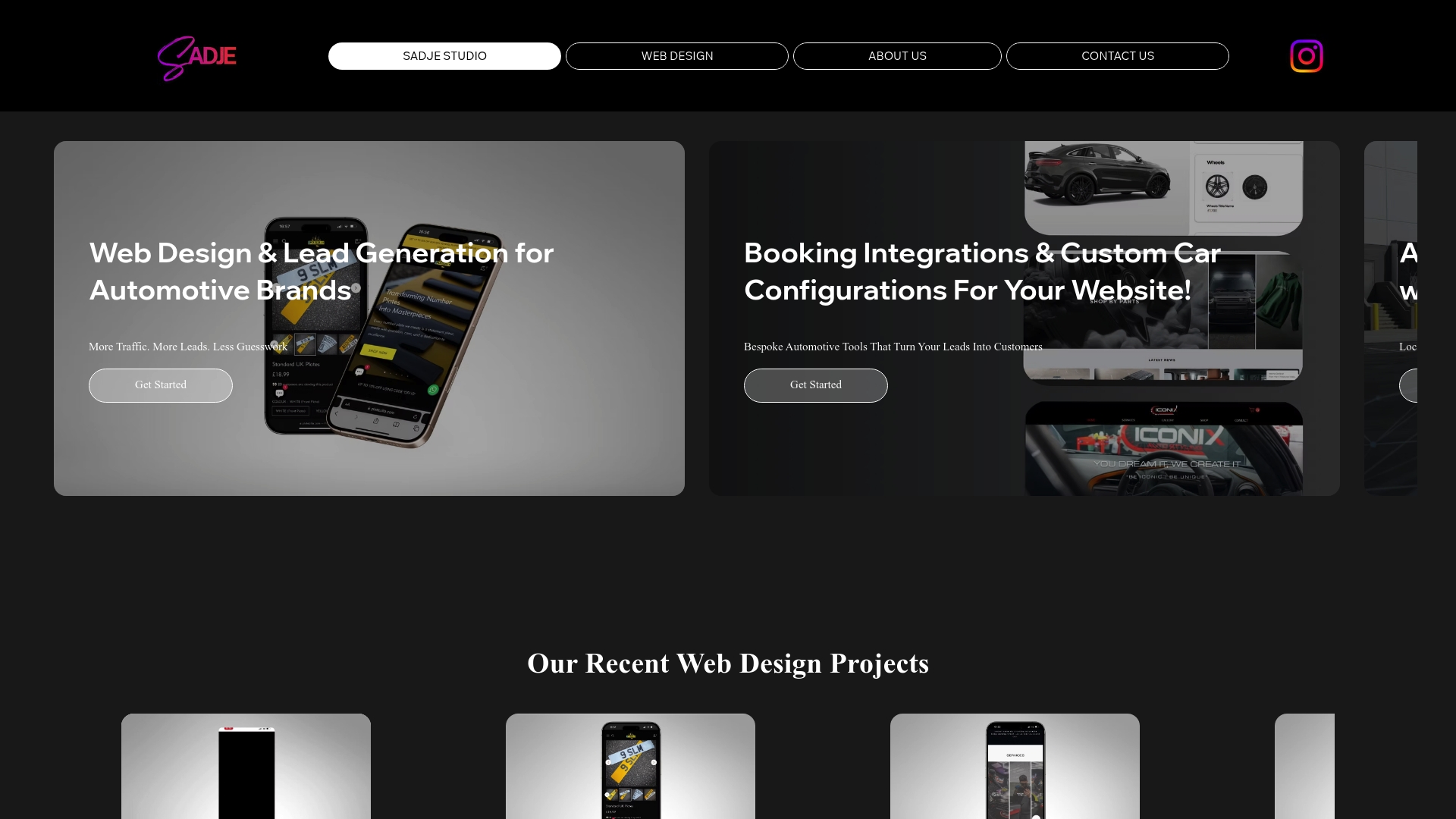
Discover how our bespoke automotive websites can transform your dealership’s online success. Visit our main website now to learn more and book a free consultation tailored to your needs.
Frequently Asked Questions
What is responsive design and why is it important for car dealer websites?
Responsive design enables your website to automatically adjust its layout based on the device being used, ensuring a seamless browsing experience for customers on smartphones, tablets, or desktops. Implement responsive design to reduce bounce rates and boost mobile search engine rankings, ultimately improving customer satisfaction within 30 days.
How can integrated lead generation tools help my car dealership?
Integrated lead generation tools centralise customer information from various interactions, allowing your sales team to respond quickly to potential buyers. Streamline your lead management process to increase conversion rates by focusing on high-value prospects, which can improve your follow-up efficiency within a few weeks.
Why should I implement online booking systems on my dealership website?
Online booking systems provide customers the ability to schedule test drives or service appointments at their convenience, eliminating the need for phone calls or email exchanges. Integrate these systems to generate qualified leads 24/7 and enhance customer satisfaction, potentially increasing your bookings by 25% in the first month.
What are dynamic vehicle listings and how do they improve user experience?
Dynamic vehicle listings allow customers to filter your inventory in real-time based on criteria such as make, model, and price range, making their search more efficient. By easily finding relevant vehicles, you can reduce bounce rates and keep customers engaged on your site, aiming for at least a 15% increase in time spent on your pages.
How can SEO and analytics contribute to my dealership’s success?
SEO improves your website’s visibility in search results, while analytics provide insights into customer behaviour and effective keywords. Focus on optimising your site for local SEO to capture more leads, aiming for improved search rankings within 60 days based on real traffic data.
How do testimonials and portfolio sections build trust with potential buyers?
Testimonials showcase authentic customer experiences and satisfaction, while portfolio sections highlight your dealership’s successes. Feature these sections prominently on your website to build credibility and increase conversion rates, potentially boosting sales inquiries by over 20% within a month.
Recommended
Comments