

How to Optimise Automotive SEO for Increased Lead Generation
- Feb 19
- 8 min read

Struggling to attract qualified leads to your British garage or dealership online often starts with overlooked SEO fundamentals. Every neglected technical detail or inconsistent local listing can push potential customers towards competitors instead. By embracing a strategic audit, targeted automotive keyword research, and on-page optimisation, you set the foundation for enhanced digital visibility and reliable lead generation. Discover how a comprehensive approach to optimising automotive SEO elements can help your business stand out in the crowded United Kingdom market.
Table of Contents
Quick Summary
Key Insight | Explanation |
1. Regular Website Audits Are Essential | Conducting website audits quarterly helps identify technical issues and improves overall online visibility for leads generation. |
2. Strategic Keyword Research Drives Traffic | Utilizing automotive-specific keyword research ensures your content aligns with potential customer searches, enhancing site visibility and attracting the right audience. |
3. Optimise On-Page SEO for Relevance | Implementing targeted on-page SEO strategies helps communicate service offerings clearly, improving search engine rankings and user engagement. |
4. Lead Generation Tools Increase Conversions | Integrating effective lead capture tools and nurturing systems creates multiple touchpoints, enhancing the chances of converting website visitors into customers. |
5. Continuous Performance Monitoring Is Key | Regularly tracking and analysing SEO performance metrics allows for timely adjustments and long-term growth in your digital marketing efforts. |
Step 1: Audit Existing Website and Local Listings
Auditing your automotive website and local listings is a critical first move in optimising your digital presence and generating more qualified leads. This comprehensive evaluation will help you identify technical issues, improve search visibility, and ensure potential customers can find you easily online.
Begin by conducting a thorough comprehensive website performance review. Your audit should cover multiple critical areas:
Technical SEO infrastructure
Content quality and keyword alignment
Local business listing accuracy
Website loading speed
Mobile responsiveness
First, examine your website’s technical foundations. Check that all pages are correctly indexed by search engines, verify your XML sitemap is current, and identify any crawl errors preventing search engines from understanding your site structure. Look for broken links, duplicate content, and ensure each page has unique title tags and meta descriptions.
A well-structured website audit reveals hidden opportunities for improving your online visibility and lead generation potential.
Next, focus on local SEO by meticulously reviewing your Google Business Profile and other local directory listings. Confirm that your business name, address, and phone number are consistent across all platforms. Incorrect or outdated information can significantly harm your local search rankings and confuse potential customers.
Key local listing verification steps:
Check Google Business Profile details
Validate information on Bing Places
Review industry-specific directories
Update contact information uniformly
Add recent business photos and accurate service descriptions
Professional insight: Conduct your website audit quarterly to stay ahead of potential technical issues and maintain optimal search engine performance.
Step 2: Implement Automotive-Specific Keyword Research
Keyword research is the strategic foundation for driving targeted traffic to your automotive website and generating high-quality leads. By understanding the precise language potential customers use when searching for automotive services, you can optimise your digital marketing approach and improve search engine visibility.
Begin by leveraging generative AI keyword research techniques to discover and analyse industry-specific search terms. These advanced tools can help you uncover nuanced keywords that traditional research methods might miss, providing deeper insights into customer search behaviours.
Your keyword research strategy should encompass several critical areas:
Long-tail automotive search phrases
Local service-related keywords
Vehicle model and make specific terms
Repair and maintenance search queries
Geographic location modifiers
Dive deep into understanding your target audience’s search intent. This means going beyond generic terms like “car repair” and exploring more specific phrases such as “BMW brake pad replacement in Manchester” or “emergency hybrid vehicle diagnostics”.
Effective keyword research transforms how potential customers discover your automotive business online.
Utilise multiple research tools to cross-reference your findings. Google’s Keyword Planner, SEMrush, and specialised automotive industry keyword tools can provide comprehensive insights. Pay particular attention to search volume, keyword difficulty, and relevance to your specific services.
Keyword research refinement steps:
Identify core service keywords
Analyse competitor keyword strategies
Explore long-tail keyword variations
Map keywords to specific website pages
Prioritise keywords with high intent
Professional insight: Regularly update your keyword strategy every three months to stay aligned with evolving automotive search trends and customer behaviours.
Step 3: Enhance On-Page SEO for Service Relevance
Optimising your automotive service pages requires a strategic approach to on-page SEO that speaks directly to potential customers while satisfying search engine algorithms. Your goal is to create content that clearly communicates your service offerings and matches user search intent.

Begin by implementing targeted on-page SEO optimization techniques that align your website content with automotive service-related searches. This involves carefully crafting your page elements to signal relevance and expertise to both users and search engines.
Key on-page SEO elements for automotive services include:
Precise service page titles
Detailed meta descriptions
Service-specific headings
Keyword-rich content
Localised service descriptions
Focus on integrating service-specific keywords naturally throughout your content. This means moving beyond generic terms and incorporating precise phrases that potential customers actually use when searching for automotive services. For instance, replace “car repair” with more specific terms like “Mercedes-Benz brake system diagnostics in Birmingham”.
Effective on-page SEO transforms your website from invisible to irresistible for potential customers.
Pay special attention to your page structure and HTML elements. Ensure your H1 title accurately describes the service, use H2 subheadings to break down specific aspects of the service, and include schema markup to provide additional context to search engines.
On-page SEO implementation steps:
Craft unique service page titles
Write compelling meta descriptions
Optimise header tags
Include location-specific keywords
Add schema markup for services
Professional insight: Regularly audit your service pages, updating content and keywords to maintain alignment with current automotive search trends and customer needs.
Step 4: Integrate Lead Generation Tools Effectively
Transforming website visitors into genuine sales opportunities requires strategic implementation of powerful lead generation tools tailored specifically for automotive businesses. Your goal is to create a seamless digital ecosystem that captures, nurtures, and converts potential customer interest.
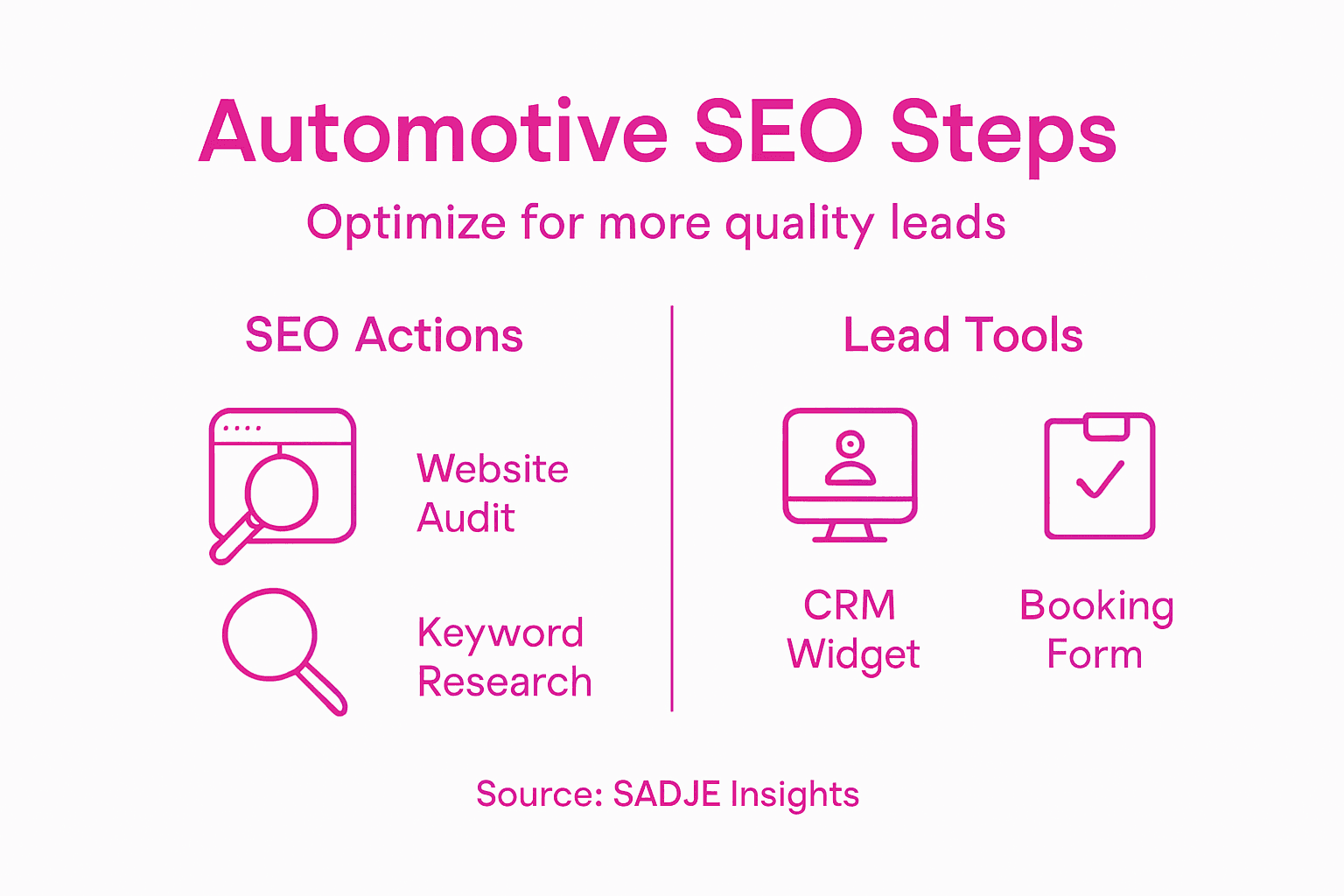
Begin by implementing automated lead nurturing strategies that guide prospects systematically through your sales funnel. These sophisticated tools help track interactions, personalise communication, and deliver targeted content at precisely the right moment in a customer’s buying journey.
Key lead generation tools for automotive services include:
Interactive vehicle quote generators
Booking and scheduling systems
Personalised email marketing platforms
Live chat support widgets
Integrated customer relationship management (CRM) systems
Focus on creating multiple conversion touchpoints across your digital platforms. This means designing intuitive website forms, implementing clear call-to-action buttons, and ensuring each interaction provides genuine value to potential customers.
Effective lead generation tools transform casual website browsers into committed potential buyers.
Prioritise tools that offer comprehensive tracking and analytics. Look for solutions that provide detailed insights into user behaviour, allowing you to refine your approach continuously and understand exactly how prospects interact with your automotive services.
Lead generation tool integration steps:
Assess current lead capture mechanisms
Select industry-specific tools
Implement tracking and analytics
Design personalised follow-up workflows
Continuously test and optimise conversion paths
Professional insight: Review and update your lead generation toolset every six months to ensure you’re leveraging the most advanced technologies available in the automotive marketing landscape.
The following table compares common lead generation tools for automotive businesses and their unique advantages:
Tool Type | User Experience | Business Impact |
Quote Generator | Fast service estimates | Encourages enquiry submissions |
Booking System | Simple online scheduling | Reduces missed sales opportunities |
CRM Integration | Personalised follow-up | Enhances lead management efficiency |
Live Chat Widget | Immediate assistance | Increases customer satisfaction |
Step 5: Monitor Performance and Adjust Strategies
Successful automotive SEO is not a one-time effort but an ongoing process of continuous monitoring and strategic refinement. Your ability to track, analyse, and respond to performance metrics will determine the long-term effectiveness of your digital marketing approach.
Begin by implementing comprehensive SEO performance tracking methods that provide real-time insights into your website’s search engine visibility and user engagement. These tools help you understand precisely how potential customers are discovering and interacting with your automotive services online.
Critical performance metrics to monitor include:
Organic search traffic volume
Keyword ranking positions
Click-through rates
Conversion rates
User engagement metrics
Dig deeper than surface-level numbers by analysing user behaviour patterns. Look for trends in how visitors navigate your site, which service pages generate the most interest, and where potential customers might be dropping off in the sales funnel.
Intelligent performance monitoring transforms raw data into actionable automotive marketing strategies.
Utilise advanced analytics tools to track granular performance indicators. This means examining not just overall traffic, but understanding the specific search queries driving visitors, the geographic origins of your leads, and the devices they’re using to access your website.
Performance monitoring action steps:
Set up comprehensive analytics tracking
Establish baseline performance metrics
Create monthly performance reports
Identify improvement opportunities
Implement targeted strategy adjustments
Professional insight: Schedule quarterly deep-dive reviews of your SEO performance, treating data analysis as a strategic planning session rather than a routine check-box exercise.
Here is a summary table highlighting the distinct benefits of each step in an effective automotive SEO strategy:
Step | Core Focus | Main Benefit |
Audit | Analysing website and listings | Uncovers technical obstacles |
Keyword Research | Targeting high-value phrases | Attracts qualified website visitors |
On-Page SEO | Improving page relevance | Increases service page visibility |
Lead Tools | Capturing and nurturing leads | Boosts sales conversion rates |
Performance | Tracking and adjusting tactics | Sustains long-term growth |
Boost Your Automotive SEO and Lead Generation with SADJE
Struggling to translate website visits into valuable leads despite your best efforts with automotive SEO strategies? The challenges of optimising local listings, conducting precise keyword research, refining on-page SEO, and integrating effective lead generation tools can feel overwhelming. SADJE specialises in building bespoke, high-performance websites tailored specifically to garages, car dealerships, and automotive service providers. We understand the critical need for seamless lead capture through tools like 3D configurators and instant quote generators that directly address the pain points of attracting qualified customers and converting traffic.
Take the guesswork out of your digital marketing performance with SADJE’s expertise. By combining advanced SEO plugins, targeted paid advertising management, and real-time analytics, we empower your business to dominate local search rankings and increase genuine enquiries. Visit SADJE today to explore how our cutting-edge solutions in automotive web development can transform your online presence and accelerate lead generation. Discover more about how our lead generation tools and tailored SEO strategies deliver measurable results that keep your business ahead in a competitive market.
Frequently Asked Questions
How do I conduct an audit of my automotive website for SEO?
To conduct an audit, start by reviewing your website’s technical SEO infrastructure, including indexing, crawl errors, and broken links. Use online tools to analyse your site’s performance and identify areas for improvement within 30 days.
What are the key elements of automotive-specific keyword research?
Key elements include identifying long-tail automotive search phrases, local service-related keywords, and specific terms related to vehicle makes and models. Begin by mapping 5-10 relevant keywords to individual service pages to improve your visibility.
How can I enhance on-page SEO for my automotive service pages?
Enhancing on-page SEO involves optimising page titles, meta descriptions, and incorporating service-specific keywords within your content. Aim to update your service pages with targeted keywords at least every quarter to keep them aligned with customer searches.
What lead generation tools should I integrate into my automotive website?
Consider integrating tools such as booking systems, live chat support widgets, and customer relationship management (CRM) systems to capture and nurture leads effectively. Assess your current tools and aim to implement at least two new solutions within the next two months.
How do I monitor the performance of my automotive SEO efforts?
To monitor performance, set up comprehensive analytics tracking and create monthly reports detailing key metrics like organic search traffic and conversion rates. Regularly review your analytics every month to identify trends and adjust your strategies accordingly.
Recommended
For anyone looking to broaden their skill set, the Global Skills Meet offers a platform filled with interactive workshops and engaging discussions. Attendees can explore a range of topics that reflect today’s most relevant skills. The event fosters a supportive community where learning is shared and celebrated. With opportunities to engage directly with facilitators, every session adds value.